
Note: This is part two of six in our BLE throughput series. See all six articles here.
When building a BLE product, PHY mode is one of the earliest configuration decisions you’ll make and one of the most foundational. The PHY layer sits at the base of the BLE stack and defines how bits are physically transmitted over the air. Everything above it, connection events, packet exchange, and application data, operates within the constraints it sets.
BLE offers three PHY modes as of version 5.0, each with different characteristics around speed, range, and interference resilience. Choosing between them isn’t always as straightforward as picking the highest number. The right mode depends on your link conditions, your environment, and what you’re actually trying to optimize for.
This article walks through each PHY mode, what the options mean for throughput in practice, and how to make the right call for your use case.
Choosing PHY Modes in BLE
The PHY layer provides one essential option in our quest for the highest throughput: selecting the PHY mode. As of BLE 5.0, the PHY modes include:
- 1M PHY (usually the default)
- 2M PHY
- Coded PHY, which generally translates to a data rate of either 125kbps or 500kbps
For more background on PHY modes checkout our article Bluetooth PHY – How it Works and How to Leverage It.
Coded PHY is designed for range and reliability rather than speed. By encoding each bit with redundancy, it achieves greater resistance to interference and longer range, but at the cost of throughput. For applications where maximizing data transfer speed is the goal, Coded PHY is generally off the table — the rest of this article focuses on 1M and 2M.
For example, consider transmitting for 1ms using 1M PHY. This means 1000 bits are sent. When using 2M PHY, 1000 bits are sent in 0.5ms. Or for the same duration of 1ms, 2000 bits are sent.
Does this mean that using 2M PHY over 1M PHY doubles throughput? Unfortunately, no. It doesn’t quite work like that. It would if the BLE radio continually transmitted in a single direction. But in reality, there are radio idle periods that are constant regardless of the PHY mode. These idle periods are the 150us tIFS and the duration between connection events that we discussed in our article on BLE Throughput Fundamentals.
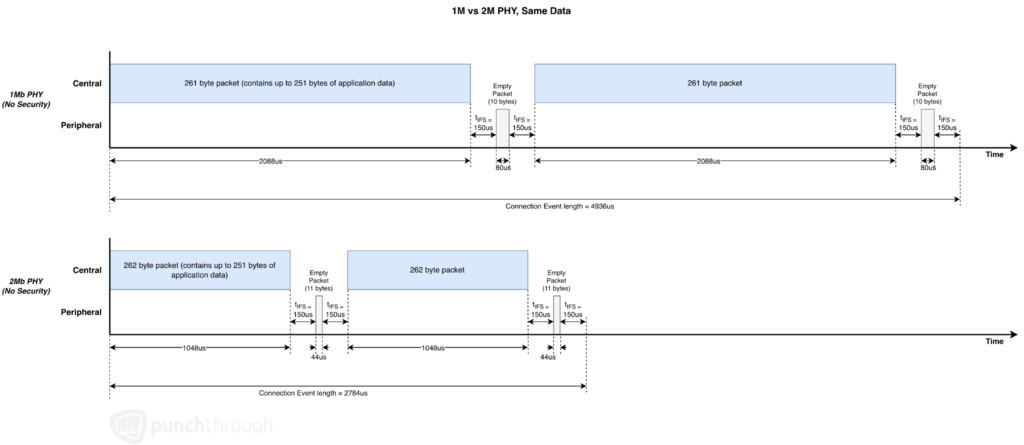
Based on the image above, the 2M PHY can send the same quantity of data in a little more than half the time. 2M PHY is 77% faster given the largest Link Layer packet sizes as shown.
Alternatively, given a fixed amount of time, 2M PHY can send nearly twice the quantity of data as shown in the image below.
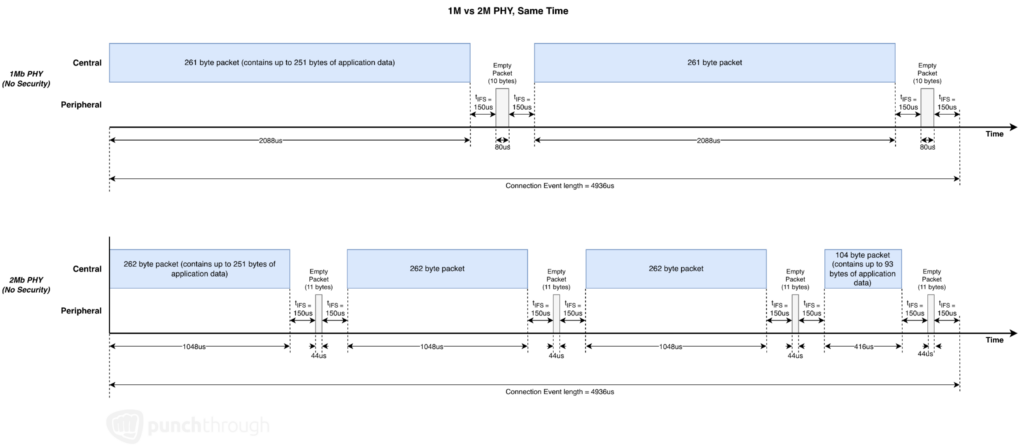
With these factors in mind, we can generally conclude that 2M PHY will provide the highest throughput. That said, there is one real scenario where that conclusion doesn’t hold.
When 2M PHY May Not Be the Right Call
When designing for fault tolerance for your use cases, you may find 2M PHY performs worse than 1M PHY. Why? The higher bitrate results in lower receiver sensitivity, making it more prone to dropped packets in high interference environments or at the edge of range. Dropped packets will end a connection event and require retries, which will negatively affect throughput.
If your BLE product involves long-range or high 2.4GHz interference, test with each mode under your expected conditions to find which mode performs best. If your device needs to operate at the edge of range, in a dense RF environment like a hospital or factory floor, or alongside active WiFi, those are the conditions where 1M PHY may actually outperform 2M.
Where to Go From Here
With PHY mode settled, the biggest remaining gains are in how you configure Data Length Extension, ATT MTU, and message sizing. And those three are worth understanding together.
Next in the series: DLE, ATT MTU, and Message Sizing — The Biggest Levers for BLE Throughput →