Connected Therapeutic Devices
FDA Approval Gets You to Market. The Connected System Earns It.

What Sets Us Apart
The Connected Medical System
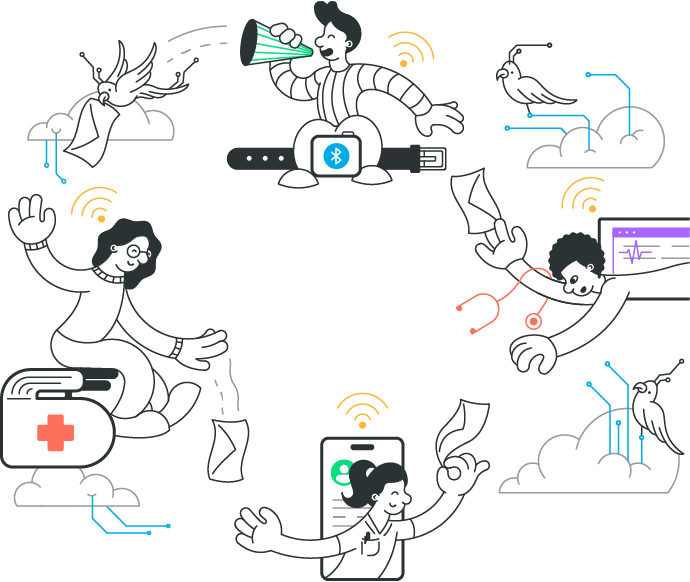
A Therapeutic Device Is One Component of a Five-Layer Connected System.
WHAT WE SOLVE FOR
The Failure Modes We Prevent Start Early.
They live at the seams between layers, vendors, and parallel tracks that never sync. These are the six we see most.

The Integrated System Gap

Architecture Decisions Made in Isolation

Security Treated as a Documentation Exercise

Partner Fragmentation at the Seams

Connected System V&V Starting From Zero

The Design History File Is Built After the Fact
Regulatory & Compliance
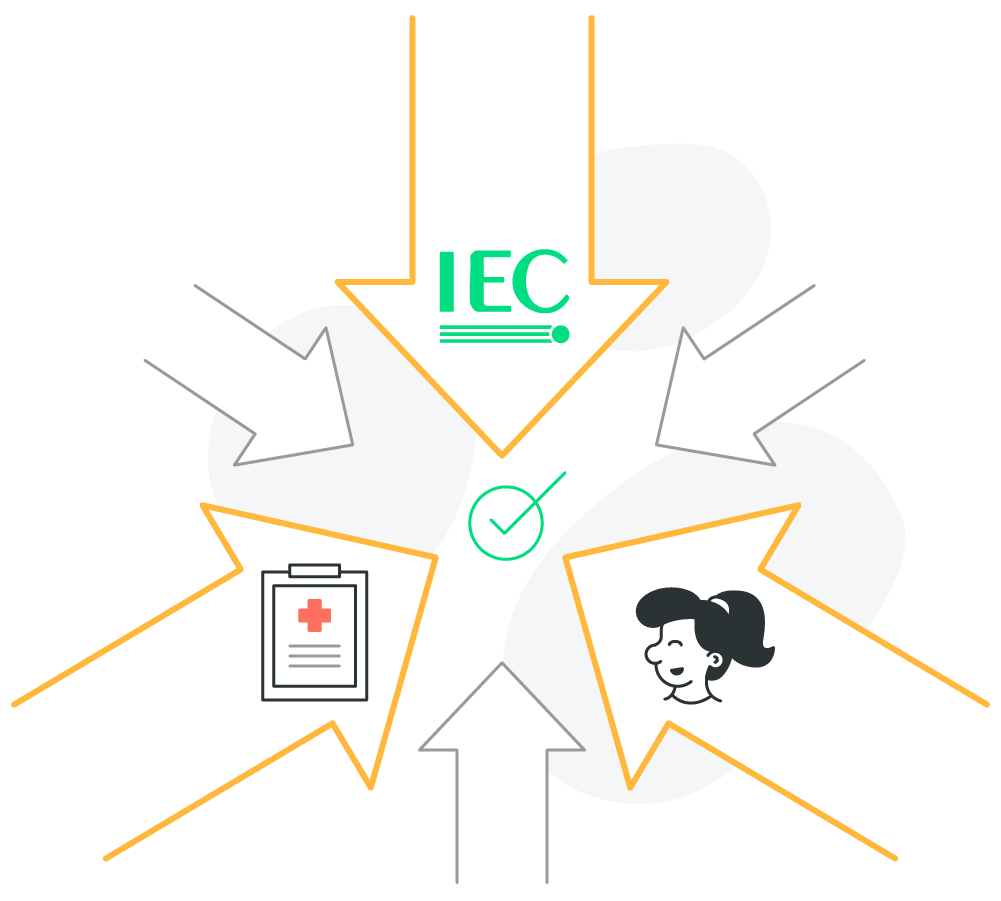
We Build Inside the Regulatory Environment. It Shapes How We Work.

SECURITY & DESIGN CONTROLS
Regulatory strategy baked into architecture from day one.
Security designed at the system level. 524B documentation generated as part of development. Design controls reflect an actual controlled process because the process was controlled from the start.
DECISION INPUTS
The right perspectives pulled into decisions early.
Some engineering decisions carry human factors, clinical, or regulatory weight, and we know which ones before they’re made. We pull those inputs in at the decision point, from your team, your advisors, or partners we recommend, so the work holds up at validation and review.

TRACEABILITY
Verification evidence built alongside the system.
Requirements trace to tests, automated and manual, across every layer as the system comes together. When your team runs system-level V&V, they start with working test infrastructure and coverage at the seams rather than building it from scratch.
The result is a device engineered for clinical use and regulatory submission simultaneously, which prevents the late-stage rework that comes from treating regulatory work as documentation applied after engineering is done.
Clinical Domains
We've Built Therapeutic Systems Across the Clinical Landscape.
That landscape spans implantable and body-worn devices, and the clinic and home workflows around them. Every domain below is grounded in delivered programs.

Implantable Neurostimulators

Implantable & Worn Hearing Devices

Cardiac Implantables & Defibrillators

Drug Delivery Devices

Respiratory Therapy Devices

Bone & Spinal Therapy Devices

Implantable Bladder & Pelvic Therapy Devices
Therapeutic Programs We've Been Trusted With.
We’re drawn to the hard problems, and these are a few of the complex connected therapies we’ve helped build.

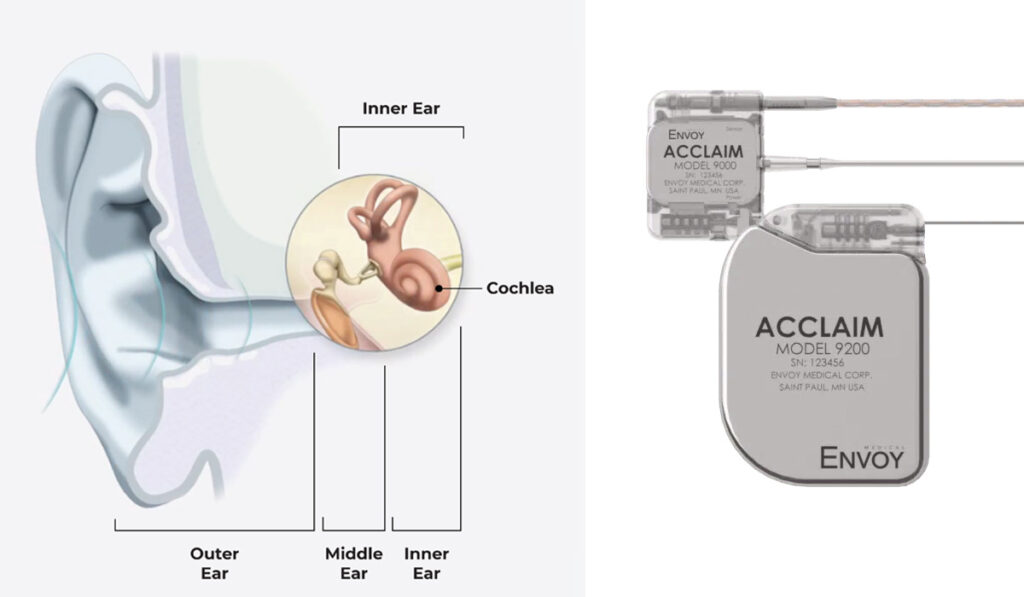
The World's First Completely Internal Cochlear Implant
Envoy built the first FDA-approved hearing device that lives entirely inside the body.
The Acclaim™ Cochlear Implant is designed for severe hearing loss, with a sensor that uses the ear’s own anatomy to capture sound in place of an external microphone.
There is nothing to take off before sleeping or showering. There is also nothing easy to power, charge, or connect, and the parts other implants keep outside the head are sealed inside, out of reach without surgery.

Sleep Apnea Therapy, Connected From Body to Cloud
Inspire® is the first FDA-approved neurostimulation therapy for moderate to severe obstructive sleep apnea.
A small implant stimulates the nerve that controls the tongue in time with the patient’s breathing, and a connected system sits around it, with a Bluetooth remote the patient holds, an app, and a clinician web portal that monitors the implant wirelessly.
For someone who could never live with a mask, that means sleeping with nothing on their face and starting therapy with a click. It also means the system around a Class III implant has moved through several device generations while every implant already placed stays in a body for years, so no part of the system can change without accounting for every implant in the field.


A Connected Care Platform Around an Implanted Insulin Pump
Portal Diabetes holds FDA Breakthrough Device designation for the Portal Pump™, an implantable insulin delivery system.
The pump is designed to sit in the abdomen, dose from a continuous glucose monitor with a heat-stable concentrated insulin, and take refills in a clinic after weeks or months.
For someone with type 1 diabetes, that means no carbohydrate counting, no meal announcements, and no waking in the night. It also means a loop that closes with no one in it, which has to be trusted before it is ever implanted and then stays in for five to seven years.


An Implanted Therapy Its Clinicians Configure From Anywhere
A stealth-stage medical startup is developing an implanted neuromodulation therapy that its clinicians can adjust without the patient in the room.
For the patient, that means a therapy that changes when it needs to instead of at the next appointment.
It also means every adjustment travels from a clinician’s screen to a device inside someone’s body, and that path has to be trusted at Class III stakes before anything is implanted.

An Implant That Turns Thought Into Touchscreen Control
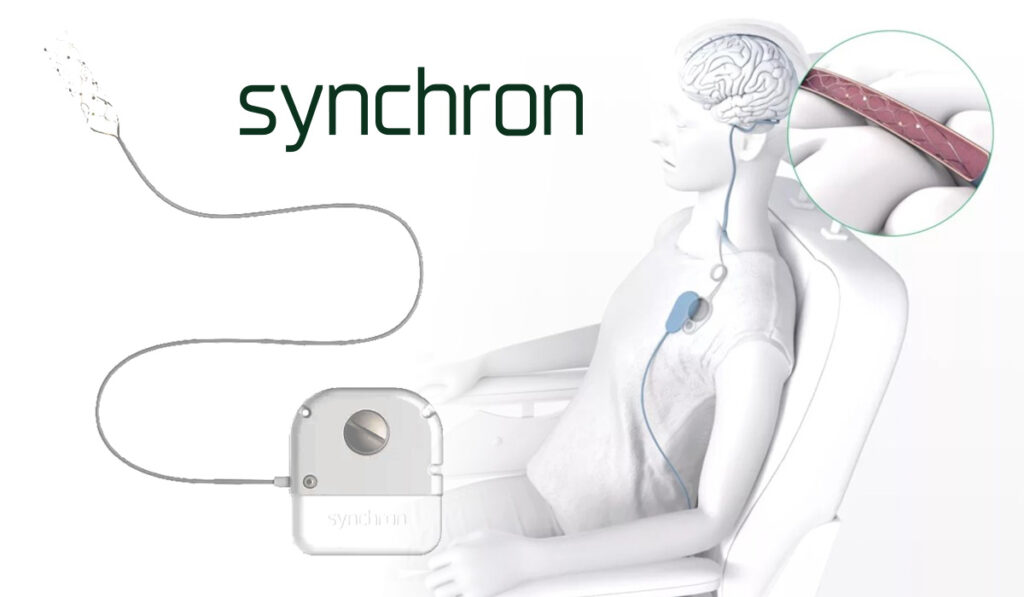
Synchron ran the first FDA-approved clinical trial of a permanently implanted brain-computer interface, and all six patients met the primary safety endpoint.
The Stentrode® is placed through a blood vessel, with no open brain surgery, and sits in a vein beside the motor cortex reading the intent to move.
For someone with severe paralysis, that means texting, browsing, and opening apps by thought alone. It also means the connection out of the body is the whole product, at Class III stakes. Nothing the implant does reaches a screen unless that link holds.
The World's First Completely Internal Cochlear Implant
Sleep Apnea Therapy, Connected From Body to Cloud
A Connected Care Platform Around an Implanted Insulin Pump
An Implanted Therapy Its Clinicians Configure From Anywhere
An Implant That Turns Thought Into Touchscreen Control
The World's First Completely Internal Cochlear Implant
Envoy built the first FDA-approved hearing device that lives entirely inside the body.
The Acclaim™ Cochlear Implant is designed for severe hearing loss, with a sensor that uses the ear’s own anatomy to capture sound in place of an external microphone.
There is nothing to take off before sleeping or showering. There is also nothing easy to power, charge, or connect, and the parts other implants keep outside the head are sealed inside, out of reach without surgery.
Sleep Apnea Therapy, Connected From Body to Cloud
Inspire® is the first FDA-approved neurostimulation therapy for moderate to severe obstructive sleep apnea.
A small implant stimulates the nerve that controls the tongue in time with the patient’s breathing, and a connected system sits around it, with a Bluetooth remote the patient holds, an app, and a clinician web portal that monitors the implant wirelessly.
For someone who could never live with a mask, that means sleeping with nothing on their face and starting therapy with a click. It also means the system around a Class III implant has moved through several device generations while every implant already placed stays in a body for years, so no part of the system can change without accounting for every implant in the field.
A Connected Care Platform Around an Implanted Insulin Pump
Portal Diabetes holds FDA Breakthrough Device designation for the Portal Pump™, an implantable insulin delivery system.
The pump is designed to sit in the abdomen, dose from a continuous glucose monitor with a heat-stable concentrated insulin, and take refills in a clinic after weeks or months.
For someone with type 1 diabetes, that means no carbohydrate counting, no meal announcements, and no waking in the night. It also means a loop that closes with no one in it, which has to be trusted before it is ever implanted and then stays in for five to seven years.
An Implanted Therapy Its Clinicians Configure From Anywhere
A stealth-stage medical startup is developing an implanted neuromodulation therapy that its clinicians can adjust without the patient in the room.
For the patient, that means a therapy that changes when it needs to instead of at the next appointment.
It also means every adjustment travels from a clinician’s screen to a device inside someone’s body, and that path has to be trusted at Class III stakes before anything is implanted.
An Implant That Turns Thought Into Touchscreen Control
Synchron ran the first FDA-approved clinical trial of a permanently implanted brain-computer interface, and all six patients met the primary safety endpoint.
The Stentrode® is placed through a blood vessel, with no open brain surgery, and sits in a vein beside the motor cortex reading the intent to move.
For someone with severe paralysis, that means texting, browsing, and opening apps by thought alone. It also means the connection out of the body is the whole product, at Class III stakes. Nothing the implant does reaches a screen unless that link holds.
Connected Medical Systems, Engineered As One.






Our latest thinking on connected medical device development.


Talk to the Team That's Built Implantables.


Quick Discovery Call

Team Consultation