
Electronics
Electronics Design for Connected Devices & Systems
We design circuit boards, power systems, and RF connectivity for medical, wellness, and consumer devices.

PCB Design
Electronics Engineering in connected systems
Hardware defines what your connected system can deliver.
Poor electronics architecture cascades through your entire product, forcing firmware workarounds, mechanical compromises, or products that can’t meet regulatory requirements.
We design electronics with system-level constraints in mind, working across firmware, mechanical, and RF engineering to ensure electronics enable rather than limit your product.
The Result: Hardware that integrates cleanly with your connected system, meets regulatory requirements, and transitions to manufacturing without costly redesigns.

What we solve for
Electronics Design & Engineering at Every Stage
Whether building from scratch, validating approaches, or resolving production issues, we bring the electronics depth you need.

Building New Products
Power Architecture & Battery Management
- Battery dying faster than projected from underestimated BLE/WiFi power draw
- Sleep mode failing to reduce power consumption due to peripheral design
- Charging circuits causing safety failures or regulatory rejection
- Power sequencing issues corrupting firmware or sensor data
RF Integration & Performance
- Antenna detuned by enclosure materials or hand proximity
- BLE/WiFi range failing requirements in target environments
- Radio coexistence causing dropped connections or data corruption
- PCB layout creating self-interference discovered during EMC testing
Regulatory-Ready Design
- Isolation barriers or leakage current failing IEC 60601 testing
- Inadequate ESD protection causing compliance failures
- Ground and shielding decisions blocking FCC and CE compliance
- Missing design documentation requiring expensive board respins
Design for Manufacturing & Test
- Component obsolescence forcing redesigns mid-production
- Missing test points preventing calibration or field diagnostics
- Layout choices causing poor yields or field reliability issues
- Assembly problems discovered after tooling investment

Validating Feasibility
Power Budget Reality Check
- Battery life achievement with real connectivity patterns and wireless duty cycles
- Sleep mode effectiveness with actual peripheral and sensor configurations
- Power consumption staying within limits across all operating modes
- Charging performance meeting both speed and safety requirements
- Battery selection balancing capacity, form factor, cost, and chemistry requirements
RF Performance in Enclosure
- Antenna range with mechanical design, materials, and hand loading
- BLE/WiFi connection reliability in target environments and use cases
- Radio coexistence without interference from other electronics
- RF compliance readiness through pre-scan testing
- Sleep state effectiveness and wake-up latency with your sensor configuration
- Real-world battery life against advertised specifications
- Power consumption during BLE advertising, connection, and data transfer
- Thermal performance under sustained operation
Manufacturing & Supply Chain
- Component availability at target volumes with acceptable lead times
- Alternative parts existing for obsolescence risk mitigation
- BOM costs staying within budget at production volumes
- Contract manufacturer ability to source and assemble specified components
- Design testability for functional verification and production calibration
Sensor & Analog Performance
- Analog front-end accuracy in target operating conditions
- Signal conditioning providing adequate signal-to-noise ratio
- Sensing approach handling environmental variations (temperature, humidity, EMI)
- Sensor feasibility validated via prototype with real-world data

Accelerating Development
Complete Hardware Design
- Schematic and layout taking longer than timeline allows
- Uncertainty about DFM and EMC considerations delaying PCB release
- Component selection paralysis from supply chain and cost tradeoffs
- Integration challenges between power, analog, and digital subsystems
RF & Connectivity Implementation
- BLE/WiFi module integration consuming engineering bandwidth
- Antenna matching and tuning requiring specialized RF knowledge
- PCB layout uncertainty about grounding and isolation best practices
- Pre-compliance testing needed before committing to certification
Design Validation & Testing
- Board bring-up revealing issues requiring fast diagnosis and fixes
- Hardware/firmware integration and rapid system validation
- Environmental testing uncovering thermal or reliability problems
- Missing design validation evidence needed for regulatory submission
- Gaps in test documentation delaying certification timeline
Manufacturing Transition
- Production test strategy undefined or incomplete
- Manufacturing documentation insufficient for CM handoff
- First article builds revealing assembly or yield issues
- Lack of bandwidth to support CM questions and design reviews
Specialized Electronics Design for Connected Devices
Hardware design that enables reliable sensing, processing, and communication in regulated applications.
RF & Antenna Design
Antenna Design & Integration
- Antenna selection for target frequency, range, and form factor
- Custom antenna design for space-constrained or implantable devices
- Antenna matching and tuning for target impedance
- Placement optimization for enclosure constraints and hand proximity
- Multi-antenna systems for diversity or MIMO
Wireless Performance & Certification
- Range and link budget optimization
- Multi-radio coexistence (BLE, WiFi, cellular, proprietary)
- Pre-compliance testing for FCC, CE, and wireless certifications
- Radiated emissions and immunity testing preparation
RF Protocol & Power Transfer
- Range and link budget optimization
- Multi-radio coexistence (BLE, WiFi, cellular, proprietary)
- Pre-compliance testing for FCC, CE, and wireless certifications
- Radiated emissions and immunity testing preparation
PCB Design & Miniaturization
Advanced PCB Technologies
- Rigid, flex, and rigid-flex circuit design in Altium Designer
- HDI (high-density interconnect) with microvias and buried vias
- Layer stackup optimization for impedance control and EMI
- Advanced materials for high-frequency or high-temperature applications
Miniaturization & Packaging
- Component placement for extreme space constraints
- Via-in-pad and advanced assembly techniques
- High-density mixed-signal integration (analog, digital, RF)
- Thermal management in compact layouts
Signal Integrity & Performance
- High-speed signal routing and impedance matching
- Crosstalk and EMI mitigation in dense layouts
- Power distribution network (PDN) design for clean power delivery
- Ground plane strategies for mixed-signal designs
Power Architecture & Battery Management
Ultra-Low Power Design
- Power budgeting across sleep, active, and transmission modes
- Peripheral and sensor selection for low-power operation
- Power sequencing and domain isolation
- Leakage current minimization techniques
Battery & Charging Systems
- Battery chemistry selection and capacity sizing
- Charging circuit design (linear, switching, wireless)
- Fuel gauging and battery management systems
- Battery protection and safety monitoring
- Closed-loop charging for implantable systems
Power Distribution & Regulation
- Multi-rail power architecture design
- Low-noise regulators for sensitive analog circuits
- Switching regulator design and layout (SMPS)
- Power-good sequencing and brownout protection
- Load switching and hot-swap protection
Precision Analog Circuit Design
Therapeutic & Stimulation Circuits
- Electrical stimulation output stages with compliance monitoring
- High-voltage stimulation and precision driver design
- Charge balancing and safety-limited outputs
- Isolation and patient-protection mechanisms
Data Conversion & Processing
- ADC selection and interface design (SAR, Delta-Sigma, Pipeline)
- DAC interface design and reconstruction filtering
- Anti-aliasing filter design
- Analog reference design and noise management
- Gain and offset calibration strategies
Biosignal & Sensor Interfaces
- ECG, EEG, EMG acquisition front-ends
- Photoplethysmography (PPG) and optical sensing
- Bioimpedance and impedance spectroscopy measurement
- Temperature, pressure, and flow sensor interfaces
- Chemical and electrochemical sensor conditioning
- Strain gauge and load cell amplification
Electromechanical Integration
Actuator Control & Drive Circuits
- DC motor control circuits with PWM and current sensing
- Stepper motor driver design and microstepping control
- Brushless DC (BLDC) motor control
- Solenoid and valve driver circuits
- Haptic feedback implementation (LRA, ERM)
Sensing & Feedback Systems
- Position sensing (optical encoders, magnetic encoders, Hall effect)
- Motion sensing (accelerometers, gyroscopes, IMU integration)
- Force and torque measurement interfaces
- Limit switch and safety interlock circuits
- Proximity and contact detection
Mechanical & Thermal Integration
- Component placement for thermal management and airflow
- Heatsink and cooling design for power components
- Connector and cable design for mechanical constraints
- Enclosure integration considerations (mounting, sealing, EMI)
- Vibration and shock tolerance design
Certification & Regulatory Readiness
Medical Device Safety Standards
- IEC 60601 electrical safety design (isolation, leakage current, protective earth)
- Means of patient protection (MOPP) and means of operator protection (MOOP)
- Applied part design and patient protection
- Creepage and clearance requirements
- Biocompatibility material selection and documentation
EMC & Wireless Certification
- EMC/EMI design for emissions and immunity (IEC 60601-1-2)
- PCB layout techniques for EMC compliance
- Shielding, filtering, and grounding strategies
- Pre-compliance testing and troubleshooting
- Wireless certification preparation (FCC Part 15/18, CE RED, IC)
Design Documentation & Traceability
- Design history file (DHF) documentation for electronics
- Requirements traceability matrices
- Design verification and validation evidence
- Risk management documentation (ISO 14971) for hardware hazards
- Change control and configuration management
Design for Manufacturing & Test
Design for Manufacturability (DFM)
- Component selection for supply chain stability and lifecycle
- PCB design rules for fabrication and assembly yield
- Panelization and depaneling strategy
- Contract manufacturer coordination and design review
- Cost optimization and value engineering
Design for Test (DFT)
- Test point placement and accessibility
- Boundary scan (JTAG) and programming interface design
- Built-in self-test (BIST) for critical subsystems
- Test coverage analysis and fault isolation strategy
Production Support & Validation
- Production test fixture design and programming
- Automated test equipment (ATE) integration
- First article inspection and yield optimization
- Calibration procedures and traceability
- Engineering liaison between product teams and contract manufacturers

RF & Antenna Design
Antenna Design & Integration
- Antenna selection for target frequency, range, and form factor
- Custom antenna design for space-constrained or implantable devices
- Antenna matching and tuning for target impedance
- Placement optimization for enclosure constraints and hand proximity
- Multi-antenna systems for diversity or MIMO
Wireless Performance & Certification
- Range and link budget optimization
- Multi-radio coexistence (BLE, WiFi, cellular, proprietary)
- Pre-compliance testing for FCC, CE, and wireless certifications
- Radiated emissions and immunity testing preparation
RF Protocol & Power Transfer
- Range and link budget optimization
- Multi-radio coexistence (BLE, WiFi, cellular, proprietary)
- Pre-compliance testing for FCC, CE, and wireless certifications
- Radiated emissions and immunity testing preparation

PCB Design & Miniaturization
Advanced PCB Technologies
- Rigid, flex, and rigid-flex circuit design in Altium Designer
- HDI (high-density interconnect) with microvias and buried vias
- Layer stackup optimization for impedance control and EMI
- Advanced materials for high-frequency or high-temperature applications
Miniaturization & Packaging
- Component placement for extreme space constraints
- Via-in-pad and advanced assembly techniques
- High-density mixed-signal integration (analog, digital, RF)
- Thermal management in compact layouts
Signal Integrity & Performance
- High-speed signal routing and impedance matching
- Crosstalk and EMI mitigation in dense layouts
- Power distribution network (PDN) design for clean power delivery
- Ground plane strategies for mixed-signal designs

Power Architecture & Battery Management
Ultra-Low Power Design
- Power budgeting across sleep, active, and transmission modes
- Peripheral and sensor selection for low-power operation
- Power sequencing and domain isolation
- Leakage current minimization techniques
Battery & Charging Systems
- Battery chemistry selection and capacity sizing
- Charging circuit design (linear, switching, wireless)
- Fuel gauging and battery management systems
- Battery protection and safety monitoring
- Closed-loop charging for implantable systems
Power Distribution & Regulation
- Multi-rail power architecture design
- Low-noise regulators for sensitive analog circuits
- Switching regulator design and layout (SMPS)
- Power-good sequencing and brownout protection
- Load switching and hot-swap protection

Precision Analog Circuit Design
Biosignal & Sensor Interfaces
- ECG, EEG, EMG acquisition front-ends
- Photoplethysmography (PPG) and optical sensing
- Bioimpedance and impedance spectroscopy measurement
- Temperature, pressure, and flow sensor interfaces
- Chemical and electrochemical sensor conditioning
- Strain gauge and load cell amplification
Therapeutic & Stimulation Circuits
- Electrical stimulation output stages with compliance monitoring
- High-voltage stimulation and precision driver design
- Charge balancing and safety-limited outputs
- Isolation and patient-protection mechanisms
Data Conversion & Processing
- ADC selection and interface design (SAR, Delta-Sigma, Pipeline)
- DAC interface design and reconstruction filtering
- Anti-aliasing filter design
- Analog reference design and noise management
- Gain and offset calibration strategies

Electromechanical Integration
Actuator Control & Drive Circuits
- DC motor control circuits with PWM and current sensing
- Stepper motor driver design and microstepping control
- Brushless DC (BLDC) motor control
- Solenoid and valve driver circuits
- Haptic feedback implementation (LRA, ERM)
Sensing & Feedback Systems
- Position sensing (optical encoders, magnetic encoders, Hall effect)
- Motion sensing (accelerometers, gyroscopes, IMU integration)
- Force and torque measurement interfaces
- Limit switch and safety interlock circuits
- Proximity and contact detection
Mechanical & Thermal Integration
- Component placement for thermal management and airflow
- Heatsink and cooling design for power components
- Connector and cable design for mechanical constraints
- Enclosure integration considerations (mounting, sealing, EMI)
- Vibration and shock tolerance design

Certification & Regulatory Readiness
Medical Device Safety Standards
- IEC 60601 electrical safety design (isolation, leakage current, protective earth)
- Means of patient protection (MOPP) and means of operator protection (MOOP)
- Applied part design and patient protection
- Creepage and clearance requirements
- Biocompatibility material selection and documentation
EMC & Wireless Certification
- EMC/EMI design for emissions and immunity (IEC 60601-1-2)
- PCB layout techniques for EMC compliance
- Shielding, filtering, and grounding strategies
- Pre-compliance testing and troubleshooting
- Wireless certification preparation (FCC Part 15/18, CE RED, IC)
Design Documentation & Traceability
- Design history file (DHF) documentation for electronics
- Requirements traceability matrices
- Design verification and validation evidence
- Risk management documentation (ISO 14971) for hardware hazards
- Change control and configuration management

Design for Manufacturing & Test
Design for Manufacturability (DFM)
- Component selection for supply chain stability and lifecycle
- PCB design rules for fabrication and assembly yield
- Panelization and depaneling strategy
- Contract manufacturer coordination and design review
- Cost optimization and value engineering
Design for Test (DFT)
- Test point placement and accessibility
- Boundary scan (JTAG) and programming interface design
- Built-in self-test (BIST) for critical subsystems
- Test coverage analysis and fault isolation strategy
Production Support & Validation
- Production test fixture design and programming
- Automated test equipment (ATE) integration
- First article inspection and yield optimization
- Calibration procedures and traceability
- Engineering liaison between product teams and contract manufacturers
WHAT YOU GET
Electronics Ready for Your Manufacturing Partner
We deliver tested electronics with the files, documentation, and traceability that manufacturers and regulators require.

Schematics & PCB Layout Files
Complete design documentation for fabrication and assembly, including component placement, routing, and design intent notes that manufacturers need to build your boards.
Bill of Materials (BOM)
Approved vendor parts with alternates and lifecycle status tracking to prevent supply chain disruptions during production.
Fabrication & Assembly Drawings
Stackup specifications, drill files, and pick-and-place data formatted for PCB fabricators and assembly houses.
Design Verification Test Reports
Documented electrical performance, power consumption, and signal integrity testing that validates your design meets specifications.
EMC Testing Support
Pre-compliance validation and representation at third-party test facilities to help you navigate FCC, CE, and other electromagnetic compliance requirements.
Design History Files (DHF)
Design inputs, risk analysis, verification records, and traceability matrices required for FDA submissions and design control compliance.
HOW WE WORK
Electronics Designed Within Your Connected System
We design electronics as part of your connected system, with manufacturing and regulatory requirements built into our process from the start.
System-level Design
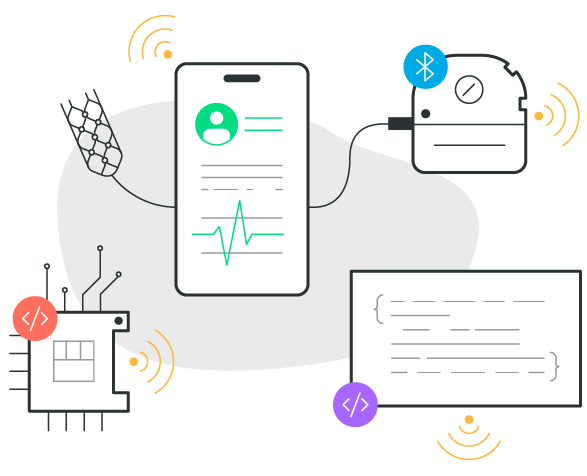
We design circuit boards within your full system architecture.
We review your system requirements, embedded software interfaces, power budgets, and sensor specifications before layout begins.
Our engineers work with your embedded, mechanical, and systems teams to align interfaces, timing, and protocols early. This prevents integration surprises and reduces rework from designing boards in isolation.
Design controls
We build FDA design control requirements into our electronic workflow.
Design History Files are part of our process, not assembled at the end. We document design inputs, risk assessments, and verification plans as we design, creating the traceability FDA expects.
Our schematics, BOMs, and test plans support regulatory submissions and design transfer from the start, providing audit-ready documentation when you need it.


Incremental validation
We validate electronic performance throughout design, not just at the end.
Circuit simulations, power analysis, and signal integrity reviews happen during schematic and layout phases. We validate critical subsystems as soon as prototypes arrive, identifying issues when changes are cheap. This catches thermal problems, EMC risks, and interface mismatches before they require expensive respins or delay validation.
Full-stack connected systems, engineered as one.



Selected work
Proven Electronics for Connected Systems
Much of our work is under NDA, but here are examples of product types where our firmware expertise enabled market-ready devices.

FDA-Approved Implantable Therapy for Obstructive Sleep Apnea

In-Hospital Contrast Delivery Equipment for Angiography Procedures

Smart Docking System for a Clinical Microneedling Device

Spectroscopy-Based Personal Urinalysis Device
Let's Talk About Your Electronics Design Challenge
Whether you’re scoping architecture, solving technical problems, or ready to build, we start with your device constraints and regulatory path.

1. Quick Discovery Call
Share what you’re building, timelines, and constraints. We’ll confirm fit and the next best step.

2. Team Consultation
We dig deeper into technical challenges, needs, and where we can add the most value.

3. Scope & Kickoff
We align on milestones, documentation, and delivery. Then we get moving and keep you informed.